


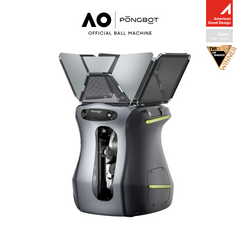
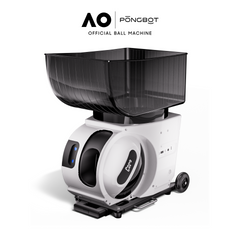
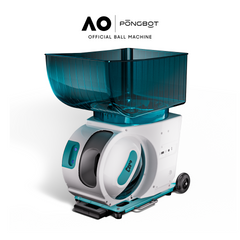

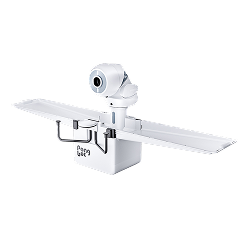


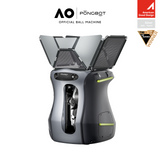
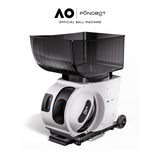
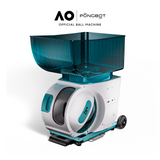





A tennis ball machine feeds, ejects, and places balls at your target speed, spin, and cadence — on repeat, without a partner. Understanding the mechanics behind the feed system, ejection wheels, and oscillation system helps you choose the right machine and get more out of every session. Here's how they work, and what AI adds to the equation.
Gravity or air-pressure loading system
Counter-rotating wheels at variable RPM
Horizontal + vertical court coverage
Vision + positioning sensors
The Core Components — What Every Ball Machine Has

Every tennis ball machine, regardless of brand or price, shares the same fundamental mechanical system. The components work together in a simple sequence: store, load, eject, place. Here's what each part does.
Ball Container
The reservoir that holds your tennis balls before feeding. Depending on the model, capacity ranges from around 50 balls in compact portable units up to 150+ balls in heavier court machines. A larger container means fewer interruptions to refill during long training sessions or drills.
Throwing Wheels
The heart of the machine. Two high-speed wheels spin in opposite directions, pinching the ball at the point of ejection. The speed differential between the two wheels determines how much topspin, backspin, or no-spin is applied. Faster wheel RPM means higher ball speed. Modern machines like the PONGBOT Pace S Pro spin wheels at up to 60 rps (revolutions per second) for heavy competitive spin.
Motor
The motor drives both the throwing wheels and the oscillation system. In basic machines, speed settings are fixed presets. In advanced machines, the motor is precisely controllable via app or remote, allowing fine adjustments to mph in real time during a session without stopping play.
Oscillation System
After the ball is ejected, oscillation rotates the machine's aim point so balls land in different court locations — left, right, deep, short — rather than all in the same spot. This turns a simple drill into realistic court coverage training. Most machines offer horizontal sweep, vertical tilt, and random modes.
The Mechanics — How a Ball Gets From Container to Court
Here's the actual sequence that happens every time a ball leaves the machine — the same fundamental mechanics described by HowStuffWorks. Understanding this process helps you calibrate your expectations for consistency, speed, and spin quality.
- Loading: Balls sit in the container above the ejection chamber. A mechanical gate or air-pressure feed drops one ball at a time into the space between the two throwing wheels.
- Wheel contact: The ball makes contact with both counter-rotating wheels simultaneously. The friction between the wheel surface and the ball is what imparts both speed and spin. Higher wheel RPM = faster ball. Differing wheel speeds = topspin or backspin.
- Ejection: The ball exits the wheel chamber at the set speed and spin angle, following a parabolic arc toward the court. The angle of the wheel housing determines the trajectory height — lower angles for flat drives, higher angles for lobs.
- Placement: If oscillation is active, the machine's aim point shifts between shots, covering different zones across the court. Random mode prevents you from predicting the next landing spot.
- Cycle repeat: The interval timer fires the next ball once the set delay has elapsed. Adjustable intervals let you simulate serve cadence or controlled rally pace.
Ball compression affects ejection consistency. New tennis balls are slightly larger and livelier than partially worn balls, which can reduce speed by 5–10%. For speed-critical training, use fresh balls and replace them when they start to lose pressure.
Traditional vs AI Ball Machines — What's the Difference?
The mechanical system above describes every ball machine. The difference between a traditional preset machine and an AI-powered machine like the PONGBOT Pace S Pro is what happens after the ball html is ejected — specifically, whether the machine responds to what you do.
| Capability | Traditional Machine | AI Machine (e.g. PONGBOT) |
|---|---|---|
| Feed adaptation | Fixed speed and interval regardless of performance | Adjusts based on your position and shot quality |
| Recovery-aware timing | Fixed interval between shots | Waits until you've recovered to position before the next feed |
| Oscillation pattern | Preset or random sweep patterns | Targets weak zones and adapts pattern based on rally performance |
| Training memory | None — each session starts fresh | Tracks session data and adapts over time |
| Shot tracking | No feedback on shot quality | Camera-based shot analysis with post-session reports |
The key distinction is determinism versus adaptation. A traditional machine follows the same program whether you're hitting well or struggling — the difficulty curve is flat. An AI machine reads your performance and shapes the session around it, increasing challenge when you're succeeding and consolidating fundamentals when you're not.
What Actually Determines Ball Speed and Spin?
Two variables control the feel of every ball a machine fires: wheel speed and the speed differential between the two wheels. Here's how each works.
Ball Speed
Wheel RPM directly controls exit velocity. The throwing wheels spin at thousands of revolutions per minute, and the ball's surface speed at the wheel circumference determines how fast the ball launches. Higher RPM = faster mph. The PONGBOT Pace S Pro reaches 80 mph (130 km/h), covering full competitive match intensity.
Topspin
Topspin is applied when the top wheel rotates faster than the bottom wheel. The ball is given forward rotation, which creates a net downward force after bounce — making it dip aggressively and kick up after the bounce. This is the most common spin in modern tennis and critical for competitive match practice.
Backspin (Slice)
Backspin occurs when the bottom wheel spins faster than the top wheel. The ball exits with backward rotation, which slows it after the bounce and keeps it lower. Useful for approach shots, drop shots disguised as drives, and training low-kicking returns.
No-Spin (Flat)
When both wheels spin at equal speed, the ball exits with minimal rotation. Flat shots travel in a truer arc with less bounce variation — harder to judge and harder to attack. Good for training timing and clean contact mechanics.
The PONGBOT Pace S Pro and Pace S both reach 60 rps — the highest maximum spin rate in the PONGBOT range. This allows players to train realistic discrimination between spin types at full speed, rather than practising spin recognition only at slower feeds.
The Oscillation System — Why Placement Matters
Without oscillation, a ball machine is only useful for drilling a single stroke in one court location. The oscillation system is what transforms it into a movement and reaction training tool. Here's what each mode does.
- Horizontal sweep: the machine rotates left and right across a set arc, feeding balls to different court positions across the width of the court. Essential for footwork drills and learning to recover to centre after wide balls.
- Vertical tilt: the ejection angle shifts between low (net-height drives), mid (baseline rally depth), and high (lobs). Trains the ability to adjust racket path and timing across trajectory types within the same session.
- Random mode: the next landing zone is unpredictable within the set parameters. Eliminates anticipatory cheating and forces genuine reaction. Critical for match-simulation training.
- 2-line and 3-position modes: preset sequences that cycle through a fixed drill pattern — useful for structured training blocks where you want deliberate variation without full randomness.
Advanced machines like the Pace S Pro add an AI layer to oscillation — the machine doesn't just sweep a preset pattern, it places balls based on where you're standing and which zones you're leaving exposed mid-rally.
AI Tennis Ball Machines — How Vision and Positioning Work

PONGBOT's AI machines add two sensing layers that traditional machines don't have: camera-based ball tracking and player positioning sensors. Together, these give the machine a basic model of each rally.
Ball tracking cameras watch the ball from ejection to landing. The machine records how fast the ball was hit, how deep it landed, and whether it landed inside or outside the target zone. This is shot quality data — not just "did you hit it" but "how well did you hit it." Research into ball machine training effects on movement coordination confirms that consistent feed timing and placement quality directly influence skill development rates.
Positioning sensors (in AI modes like PONGBOT's Recovery Trigger) track where you are on the court between shots. The machine knows whether you've recovered to centre before the next feed fires. If you're still moving, it waits. This is what makes AI training feel like practising with a real coach who reads your readiness.
The combination — ball quality data plus player position data — allows the machine to make decisions about the next feed: speed up when you're handling the pace well, drop to a more manageable speed when you're struggling, place balls to the zones you're leaving open, and hold the next feed until you've actually recovered to position.
PONGBOT's Recovery Trigger mode is available on the Pace S Pro. The machine uses positioning data to sync every feed to your actual recovery rhythm — not a pr htmleset interval. This eliminates the common frustration of balls arriving while you're still moving to position.
Understand the Machine, Choose the Right One
Every tennis ball machine works on the same principles: feed, ejection wheels, spin control, and oscillation. The difference between models is in the precision of those controls and, with AI machines like the PONGBOT Pace S Pro, whether the machine can adapt to what you do. Understand the mechanics, then match the machine to your training goals.
Continue reading: High-Speed Tennis Ball Machines — Top Speeds, AI Modes, and How to Choose →
Frequently Asked Questions
How does a tennis ball machine actually launch the ball?
A ball is dropped between two high-speed wheels spinning in opposite directions. The wheels grip the ball by friction and fling it out at the set speed and spin. The angle of the wheel housing determines the trajectory — lower for flat drives, higher for lobs. This is the same principle used in every tennis ball machine regardless of brand or price.
What determines how much topspin or backspin a machine can produce?
The speed differential between the two throwing wheels. If the top wheel spins faster than the bottom wheel, the ball exits with topspin. If the bottom wheel spins faster, it exits with backspin. Equal wheel speeds produce a flat, no-spin shot. The maximum spin rate a machine can achieve is limited by its motor power and wheel design — the PONGBOT Pace S Pro reaches 60 rps, the highest in the PONGBOT range.
Do tennis ball machines need maintenance?
Basic maintenance involves cleaning the throwing wheels of accumulated lint and debris, checking that the ball feed mechanism moves freely, and storing the machine with the ball container empty to prevent compression set in the balls. The battery should be charged regularly even during periods of non-use — letting a lithium battery fully discharge repeatedly reduces its capacity over time.
What is the difference between a traditional and an AI tennis ball machine?
A traditional machine executes a fixed program: you set speed, spin, interval, and oscillation, and it repeats that program regardless of how you're performing. An AI machine like the PONGBOT Pace S Pro uses cameras and positioning sensors to watch your shots and adjust the session accordingly — it speeds up when you're handling it well, slows when you're struggling, and waits for you to recover before the next feed. The underlying ball mechanics are the same; the difference is adaptability.
How accurate is the oscillation on a ball machine?
Modern machines are highly accurate in placement. The oscillation system uses stepper motors or servo motors to position the ejection head precisely, and the targeting is consistent within a few centimetres across the court. Random mode introduces genuine unpredictability within the set arc rather than a fixed repeating pattern. Advanced AI machines can target specific court zones based on where you're standing, which is more precise than any preset oscillation pattern.
Can I use a tennis ball machine for match simulation training?
Yes — and this is where AI machines like the PONGBOT Pace S Pro genuinely excel. Match Challenge mode lets you upload footage of real opponents or rally patterns, and the machine recreates those sequences for targeted practice against specific playing styles. Combined with Recovery Trigger (waits for you to recover before each feed) and Adaptive Rally (adjusts difficulty based on your performance), AI machines can simulate genuine match pressure better than any preset program.
Related Collections
Explore more PONGBOT machines and training tools.


