










1. Returning to the Table After Starting a Career
Sebastian first learned to play table tennis in high school, but university, work, and other commitments eventually took him away from the sport for almost 15 years.
He returned almost by accident when his workplace introduced a table. What started as casual games with colleagues quickly brought back something he had missed.
“I started remembering how much I enjoyed the game’s speed, the strategy behind each point, and the feeling of trying to solve an opponent in real time.”
The more he played, the more familiar that feeling became. Table tennis gave him a combination he had always enjoyed: physical movement, technical skill, problem-solving, and competition.
Returning to the sport also made him think differently about his physical preparation.
Sebastian already had a regular gym routine, but he realized that general fitness was different from preparing specifically for table tennis. He began adapting his training around movement, stability, strength, and recovery, helping him stay effective through longer sessions and competition nights.
What started as a return to an old hobby gradually became something more serious.
“I didn’t just want to hit the ball for fun. I wanted to understand the game again, improve properly, and see how far I could take it.”
That curiosity brought Sebastian back into structured training and competition, and gave him a reason to keep looking for better ways to practise.
2. Making Room for Table Tennis, On His Own Terms
Sebastian works full-time as a Design Manager, while the gym, family, and other commitments also compete for his time. He wanted to train consistently without having to organize his life around finding a coach or training partner.
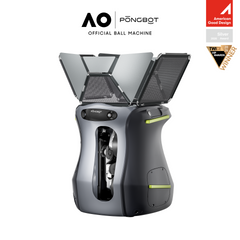
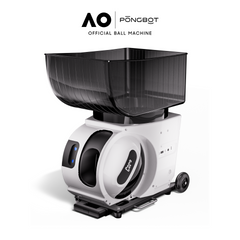
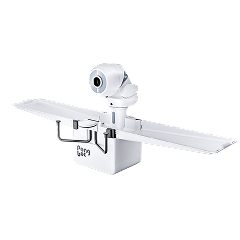
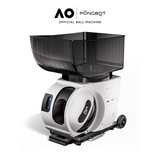
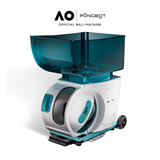
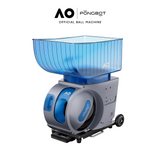
He created a table tennis training space in his garage. Pongbot Nova fits naturally into that environment. Its compact tabletop design allows him to place it directly on the table when he wants to train. That makes it practical for the way Sebastian actually trains.

He can train at home before or after work, on a weekend, or whenever he has 45–60 minutes available. During regular competition periods, he typically combines around three robot sessions a week with his club competition night.
“The biggest advantage is independence. I don’t need to wait for someone else to be available or ask a training partner to feed the same difficult ball repeatedly.”
More importantly, Pongbot Nova gives him control over what those sessions are for.
Rather than simply hitting whatever ball comes next, he can create a drill around a specific objective, repeat a particular situation, and change the ball pattern as he improves.

“If a match reveals something I need to improve, I can go home, recreate the situation, and start working on it.”
For Sebastian, having the ability to decide what to practise is what makes limited training time useful. A session can be built around one problem rather than becoming another general practice session.
3. From Identifying Weaknesses to Targeted Training
For Sebastian, the most useful training problems usually come directly from competition.
After a match, he thinks about the situations that caused him difficulty: a particular spin he struggled to read, a difficult placement, a serve he could not handle, or a rally pattern where he kept making the same decision.
He often uses ChatGPT as an analysis tool to break those situations down and work out what he needs to practise. Nova then gives him a way to turn that analysis into physical, repeatable training.
“Pongbot turned solo practice from simply hitting balls into a way of recreating the problems I face in matches and systematically working through them.”
The process has gradually become:
Match → Identify the problem → Analyse it → Build a training pattern → Practise with Pongbot → Test it again in a match.

One example was his backhand against a long, deep backspin ball.
Sebastian found this situation uncomfortable. He would often hesitate, push the ball back, or step around to use his forehand because he trusted it more. But stepping around created another problem: If he was late, he could end up playing the forehand from a poor position, exposing more of the table and using more energy.
So he made the backhand opening a specific training priority.
He started with a simple drill, having Nova repeatedly send a long backspin ball to his backhand. The goal was to develop a controlled, spin-heavy opening rather than trying to hit a winner.
Once that became more comfortable, he changed the drill. The first ball remained a long backspin to the backhand, but the second ball became topspin. Then he varied the second ball between the backhand, elbow, and forehand, forcing himself to recover and respond to what came next.

The drill evolved into a sequence much closer to what he would actually encounter in competition:
Long push → Backhand opening → Recover → Read the next ball → Continue the attack.
“I’m not interested in developing strokes that only work during isolated practice. I want the training to represent situations I will actually encounter in a match.”
The ability to build and adjust the drill allowed him to progress gradually from a single technical problem to a more complete match situation. The backhand went from something he tended to avoid to another option he could use with confidence.
Now, when he moves well and reads the ball early, opening with his backhand feels more natural. He no longer needs to rely on his forehand every time. Instead, he can open with his backhand, recover, and wait for the right opportunity to use his forehand.
He applied the same approach when changing rubbers. While the new rubber improved his attacking strokes, it changed his short game. His usual pushing technique no longer produced the same result.
Using Nova, he repeated backspin drills while adjusting his racket angle, contact, and timing.
Once the basic touch became predictable, he connected it to a more complete sequence:
Short push → Recover → Long backspin → Opening loop.
“It isn’t only useful for repeating a stroke. It can also be a way of controlling variables while you learn.”
That is how Sebastian has gradually developed his own training system. He can isolate a problem when he needs to understand it, repeat it enough times to make a change, and then introduce variation to see whether the change holds up in a more realistic situation.
The machine provides the consistency. Sebastian decides what that consistency is being used to train.
4. Taking the Game to the Next Level with a Broader Perspective
Sebastian’s progress has gone beyond improving individual strokes. When he first returned to table tennis, he was mainly focused on executing each shot correctly. Now, he pays more attention to how points develop, how one shot sets up the next, and what he could have done differently.
His serve, for example, is increasingly part of a larger sequence. He now thinks about the return he wants to create and how to follow it up with his third ball.
His Ratings Central results provide some context for this period of development. Sebastian began recording WTTA competition results in A3 in September 2025 with an initial rating of 800. During 2026, he moved into A2 and reached a rating as high as 946, with the latest recorded rating at 918.
He sees those numbers as part of the bigger picture rather than the result of any single piece of equipment or training method. What matters to him is the process behind them: competition gives him information, analysis helps him understand it, and training with Pongbot gives him a way to work on it.


There are still plenty of weaknesses in his game, and that is part of what keeps him interested.
“Every match gives you something new to work on.”
The game he returned to after 15 years is still giving him the same thing he enjoyed in the first place: problems to solve.
5. Designing a More Purposeful Training Routine with Nova, Unlocking New Possibilities
Table tennis has become part of Sebastian’s life again. For Sebastian, Pongbot Nova has become a reliable partner for the difficult parts of training.
“Pongbot has become an important part of that process because it gives me the freedom to decide when, how and what I want to train. I can take something that gave me trouble in a match, recreate it in my garage, work through it systematically and then take that improvement back into competition.”

That freedom is especially meaningful for players who take their sport seriously while balancing work and everyday life.
Perhaps that is the designer in Sebastian: turning limited time, space, and resources into more possibilities, continually refining what matters and finding ways to keep things alive.
For Pongbot, it is a privilege to be part of that journey, alongside people like Sebastian who keep finding ways to grow, create, and make more of the life they want to live.


